

Over seven tonnes of Prades hops in a new Damm campaign
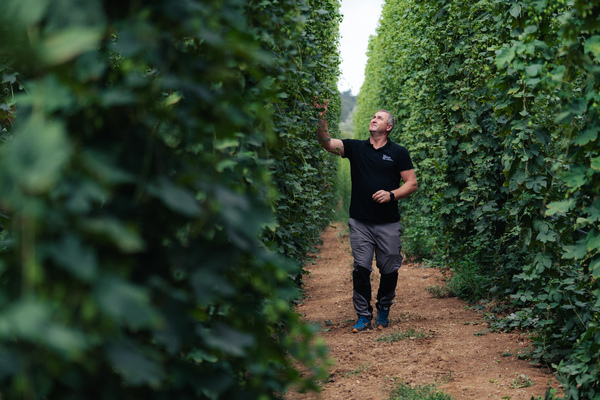
The growing of Mediterranean hops in Prades in partnership with Prades Town Council and the local Agricultural Cooperative is an example of agronomic innovation, sustainability and commitment to the region
Prades is launching a new Mediterranean hop campaign that’s once again expected to produce over seven tonnes. The project, jointly undertaken by Damm, Prades Town Council and the local Agricultural Cooperative, is the result of over a decade’s work to adapt this crop to the environmental conditions and move towards a model based on agronomic innovation, proximity and an association with the region.
Since the first harvest in 2017, the project has gradually grown in terms of production and the cultivated area. 3,100 kilos of hops were harvested in 2019 and 6,000 in 2020, a trend that consolidated the viability of the crop in the area. The plantations currently extend over more than seven hectares and production in 2026 is expected to once again exceed seven tonnes, in line with the volume achieved last year.
“In Prades we grow three varieties of hops (Nugget, Centennial and Willamette), selected due to their excellent adaptation to the environmental conditions and their organoleptic characteristics. This combination enables us to obtain different profiles and work with locally sourced raw materials which we then incorporate into some of our beers, especially the Complot IPA”, declared Kevin Tejedera, the agricultural engineer tasked with the project and raw material sustainability at Damm.
Farming in the region began in 2014, following the discovery of wild hops in the area. Subsequent studies discovered that factors such as altitude and rainfall and the thermal range in Prades provided favourable conditions for growing them, ones comparable in some ways to those of the major production regions in Central Europe.
Agricultural innovation to adapt the crops to the region
The evolution of the project has gone hand in hand with an ongoing research and innovation process. Over the years, Damm has furthered its knowledge of the performance of hops under the specific conditions of Prades, selected the varieties best suited to the territory and perfected its agronomic practices and the transformation processes for the raw materials.
In recent years, this innovation process has, above all, been focused on reinforcing the crops’ resilience to the effects of climate change, including periods of drought and rising temperatures.
In order to improve soil health, encourage water retention, reduce the use of external resources and promote biodiversity, a pilot project based on generative agriculture has been rolled out in the hop fields.
The measures implemented include directed sheep grazing to allow natural weed control without the need for herbicides and other demanding manual tasks. The sheep feed on the vegetation located in the lower part of the field, an area particularly sensitive to the proliferation of fungi and diseases, without being able to reach the flowers, which develop several metres above the ground.
The project also maintains plant cover between the rows of crops by planting herbaceous species to help prevent soil erosion, improve water and nutrient retention and promote biodiversity. As well as these actions, there exists a strategy featuring organic fertilisation based on certified products that abide by the soil’s natural cycles.
An initiative that generates value in the region
Beyond its agronomic dimension, hop growing contributes to diversifying agricultural activity in Prades while generating new economic opportunities linked to the primary sector.
Damm maintains a direct link with the farmers involved in the project, providing them with technical advice and undertaking to purchase their harvests. The company also has its own operations that employ local labour. A total of around 25 people take part in the different phases of the process each year, from the fieldwork to the subsequent processing of the hops. This activity helps to diversify the town’s primary sector, generating new opportunities for generational change in the countryside and establishing a network of producers committed to sustainable and local agriculture.
Furthermore, a large part of the value chain focuses on the municipality itself. Once harvested, the hops are transferred to the Damm processing centre located at the facilities of the Prades Agricultural Cooperative, where the drying and pelletising take place. The whole procedure is supervised by Damm’s technical team, guaranteeing full traceability and a constant quality standard throughout the value chain.

